ANSI Flange and Bolt Dimensions - 150 lb to 2500 lb - ASME/ANSI B16.5
Diameters and bolt circles for standard ASME B16.5 flanges - 1/4 to 24 inches - 150 psi to 2500 psi. All measurements in inches. Click on the required pressure below.
150 PSI
| Nominal Pipe Size NPS | Flange Diameter | Bolts | Bolt Diameter | Bolt Circle |
|---|---|---|---|---|
| 1/4 | 3-3/8 | 4 | 1/2 | 2-1/4 |
| 1/2 | 3-1/2 | 4 | 1/2 | 2-3/8 |
| 3/4 | 3-7/8 | 4 | 1/2 | 2-3/4 |
| 1 | 4-1/4 | 4 | 1/2 | 3-1/8 |
| 1-1/4 | 4-5/8 | 4 | 1/2 | 3-1/2 |
| 1-1/2 | 5 | 4 | 1/2 | 3-7/8 |
| 2 | 6 | 4 | 5/8 | 4-3/4 |
| 2-1/2 | 7 | 4 | 5/8 | 5-1/2 |
| 3 | 7-1/2 | 4 | 5/8 | 6 |
| 3-1/2 | 8-1/2 | 8 | 5/8 | 7 |
| 4 | 9 | 8 | 5/8 | 7-1/2 |
| 5 | 10 | 8 | 3/4 | 8-1/2 |
| 6 | 11 | 8 | 3/4 | 9-1/2 |
| 8 | 13-1/2 | 8 | 3/4 | 11-3/4 |
| 10 | 16 | 12 | 7/8 | 14-1/4 |
| 12 | 19 | 12 | 7/8 | 17 |
| 14 | 21 | 12 | 1 | 18-3/4 |
| 16 | 23-1/2 | 16 | 1 | 21-1/4 |
| 18 | 25 | 16 | 1-1/8 | 22-3/4 |
| 20 | 27-1/2 | 20 | 1-1/8 | 25 |
| 24 | 32 | 20 | 1-1/4 | 29-1/2 |
What is DN?
DN stands for 'Diameter Nominale'. Put simply, it is a rough translation of mm from imperial sizes, assuming that an inch is 25mm. We refer to a 12" flange as DN300, when in fact it is 304mm.
| Imperial to DN Translation Table | ||||
|---|---|---|---|---|
| 1/2" | DN15 | 6" | DN150 | |
| 3/4" | DN20 | 8" | DN200 | |
| 1" | DN25 | 10" | DN250 | |
| 1 1/4" | DN32 | 12" | DN300 | |
| 1 1/2" | DN40 | 14" | DN350 | |
| 2" | DN50 | 15" | DN375 | |
| 2 1/2" | DN65 | 16" | DN400 | |
| 3" | DN80 | 18" | DN450 | |
| 4" | DN100 | 20" | DN500 | |
| 5" | DN125 | 24" | DN600 | |
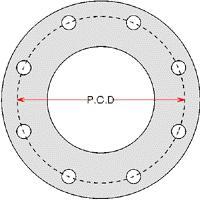
What is the PCD?
The PCD of a flange is one of the critical dimensions. PCD (Pitch Circle Diameter) is the diameter of a circle that goes through each of the bolt holes.
There are several standards for flanges, and we deal with four of them.
British Standard - BS10
- Table D
- Table E
- Table F
- Table G
- Table H
- Table J
- Table K
Table E is the most popular for applications with water. All dimensions are specified in inches.
Australian Standard - AS2129
- Table C
- Table D
- Table E
- Table F
- Table G
- Table H
- Table J
These flanges are equivalent to the BS10 flanges, except that all dimensions are specified in mm. In some sizes, bolt holes are slightly larger to give better clearance.
American National Standards Institute (ANSI)
- ANSI 125
- ANSI 150
- ANSI 300
- ANSI 600
- ANSI 900
- ANSI 1500
Higher numbers denote higher pressures.
Sometimes people use the word 'Class' instead of ANSI. e.g. an ANSI 150 flange might be called a 'Class 150'
All dimensions are specified in inches
British Standard - BS4504
- BS4504-6
- BS4504-10
- BS4504-16
- BS4504-25
- BS4504-40
- BS4504-64
- BS4504-100
- PN6
- PN10
- PN16
- PN25
- PN40
- PN64
- PN100
Engineers use the prefix PN (Pressure Nominale). e.g. a BA4504-16 flange will commonly be referred to as a PN16
Generally, a PN16 flange is designed to withstand pressures up to 16 bar.
All dimensions are specified in mm.